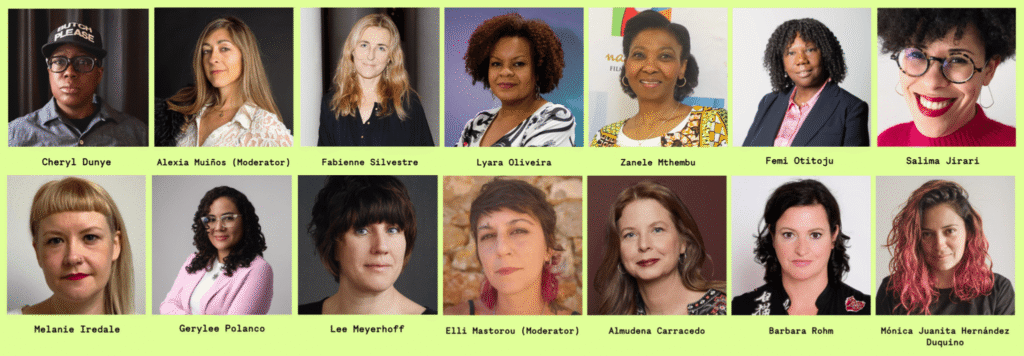
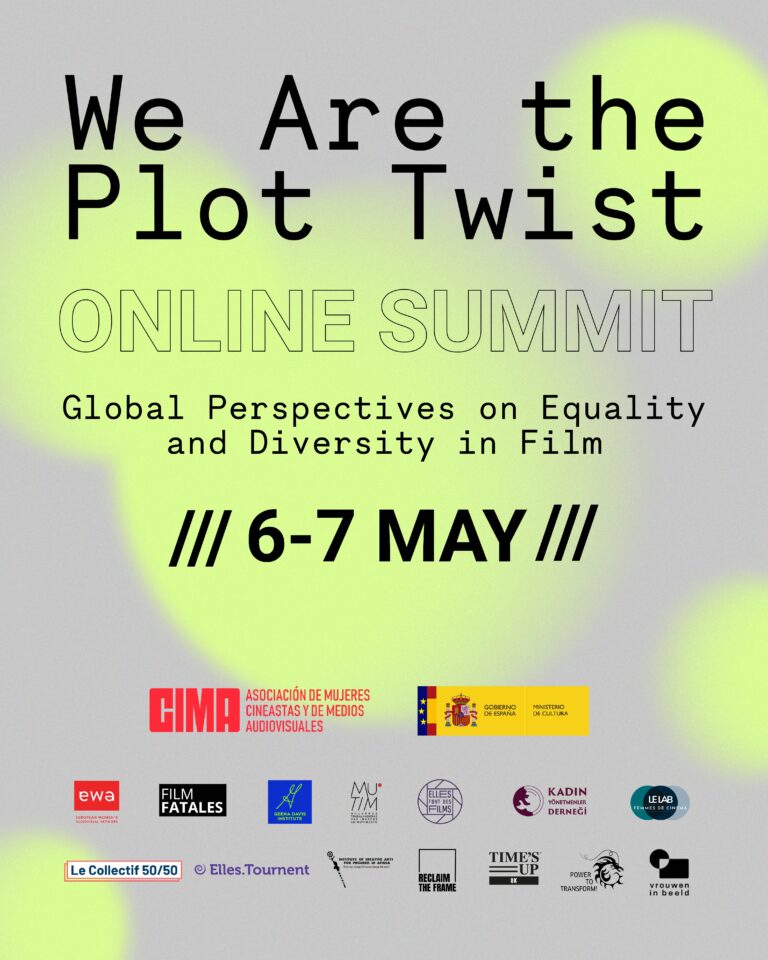
On May 6 and 7, 2026, more than 400 people attended the first international online seminar organised by CIMA – Association of Women Filmmakers and Audiovisual Media, within the framework of the Global Network Equality in Film, and funded by Spain’s Ministry of Culture. The event, which was collaboratively designed together with the associations from different countries that make up the Network, brought together around fifteen professionals, researchers and leaders of global organisations with the aim of debating strategies to move towards an equal and diverse audiovisual industry.
The first panel discussion focused on analysing public policies and concrete measures aimed at increasing the presence of women and underrepresented groups in storytelling. Representatives from France, Brazil, South Africa, and Spain shared data and experiences on financial incentives, quotas, and affirmative action programs for women and historically discriminated groups.
On-screen representation and how to challenge stereotypes was another of the meeting’s major themes. The speakers emphasised that diversity behind the camera directly influences the creation of more plural narratives and shared inspiring experiences from the US, UK, Spain, and Colombia.
Another of the talks focused on sexual violence and abuses of power within the film industry, which is marked by precariousness and the fear of speaking out. Various experts from Spain, Germany, Colombia, and Belgium provided studies and useful tools to raise awareness among professionals, as well as measures for redress and action that can be implemented by the relevant institutions.
The event concluded with a masterclass by American filmmaker Cheryl Dunye, a pioneering figure in African-American queer cinema. Dunye spoke about her iconic film The Watermelon Woman (1996), the first feature film directed by a Black lesbian woman and winner of the Teddy Award at Berlinale.